Showing posts with label Memoir. Show all posts

Wednesday, January 7, 2015

Brown Girl Dreaming

by Jacqueline Woodson
January 6, 2015

Brown Girl DreamingBrown Girl Dreaming by Jacqueline Woodson
My rating: 5 of 5 stars

Jacqueline Woodson's memoir in verse form.  A strong contender for the Newbery Medal.  This has been on many Best of 2014 lists.  Such a beautiful, enjoyable, touching book.


In the 2015 Reading Challenge this is "A book with a color in the title."
View all my reviews

Thursday, November 8, 2012

Giving Up The Ghost

by Eric Nuzum
October 28, 2012

I heard the author of this book being interviewed on public radio.  I only caught a small part of the interview, but  it hooked me.  I was interested in the story of the ghost that Eric Nuzum said haunted him throughout his life. It obsessed him so much that he began to visit haunted places throughout the country.

But that's not what this story is really about. The subtitle actually describes is in a nutshell: "friendship, 80's rock, what it means to be haunted". 

This is a memoir - a true story. Eric Nuzum now works for NPR, but as a teenager, he was a misfit. At least, that's how he felt. He dealt with a terrible depression but didn't get the right kind of help.  Drugs and alcohol didn't help. But one thing that did help was his friendship with an enigmatic, unusual girl named Laura. She was Eric's one true friend.

He really was haunted throughout his life by the ghost of a little girl in a blue dress. Whether she was a "real ghost" or a ghost of the mind is not clear. It doesn't really matter, though, because the fact that Eric was haunted by her was real enough.

I love memoirs and this one didn't disappoint. It wasn't an easy story to read because it dealt with the sad and troubling depression that the author lived through.  But knowing that Eric Nuzum is now working and seems to be doing well helps to find hope in the book.  This would be a good memoir for older teenagers, along the lines of The Burn Journals by Brent Runyon.

Saturday, July 21, 2012

Drama

An Actor's Education
By John Lithgow
May 2012

I almost forgot about this one.  I listened to this memoir because of a friend's recommendation. She especially liked Lithgow's story of how reading aloud to his critically ill father helped the healing and recovery process.  I agree. That was an excellent story.  The rest of the book is just as good.  It is really Lithgow's account of his journey from childhood to his present career.  In fact, the book really ends when his movie career takes off.

I didn't know that John Lithgow began as purely a theater actor. He may have remained in the theater and been perfectly happy, but Hollywood called and the rest is history. 

I loved the accounts of his early life. His father was a theater producer and director, working primarily in summer theater and college theater.  John, who always wanted to be an artist, found his true calling by working in his father's productions.

I listened to the audiobook, which was narrated by Lithgow himself.  It was a little strange, at first. He read the book as if he was reading anyone else's book. But as the recording progressed, it became more and more conversational.

Very very good.


Monday, May 28, 2012

Hole In My Life

by Jack Gantos
May 2012

I've been seeing this book on the library shelves for years. It never appealed to me. You can't judge a book by its cover, but I did just that.
It wasn't until I listened to Dead End in Norvelt  written and narrated by Gantos that I took another look at it. A friend told me about it.

This is a memoir about the time Jack Gantos spent in jail for smuggling drugs.  He was just out of high school and fell in with the wrong people. Gantos wanted to be a writer, but he had no money and his parents were near financial ruin.  In 1972 he was offered $10,000 to help sail a boat into New York and help sell the cargo of hash.  It was one of those "just this once" deals.  Then he'd take the money and get into a good writing program.
Well, we know the rest of the story. That's prisoner Gantos on the front cover of the book.  We also know the rest of the rest of the story. He's now a successful author and not a drug dealer. So there's a lesson to be learned from this book. As a matter of fact, the first time I heard of this book it was when a teacher wanted to check out every copy the library had in order to get his students to read it.
It's about making mistakes, regrets, remorse, forgiveness, and moving on.  I enjoyed reading (listening to) it.  You can't judge a book by its cover after all.

Saturday, May 5, 2012

Devastated

A Daughter's Journey Through Tribulation
by Cherie Morgan
March 2012

So I was in an airplane flying to Philadelphia for a library conference. As the stewardess walked through the cabin, she began chatting with me and my traveling companions. It came out that we were librarians. The stewardess said, "Oh, wait just a second. I have something you might like to see."  She came back with this book.
Of course the stewardess was Cherie Morgan and the book was Devastated.  She gave one to each of us, hoping that we'd read a little and give our opinions.  I was the only one of us three who kept reading it. I actually bought a copy.

The plot grabbed my attention immediately.  What would you do if you found out that your father had been arrested for possessing child pornography?   That's the plot and it's a true story.  It happened to Cherie Morgan.

This book is self published and is badly in need of an editor. Ms. Morgan sometimes gives way too much back story on her own life. It's interesting, in a way, but not always pertinent to the plot.  In fact, the book really ends up being the story of Cherie Morgan's life rather than the story of how she dealt with the issue of her father's crime and arrest.  I wanted to know more about how she dealt with it. I wanted to know more about the investigation and the trial. I wanted to know how she felt about having left her children in the custody of this pedophile for so long. How did her children feel about it?

Cherie Morgan is a pretty interesting person and certainly had an interesting life.  I'd like to see her re-write this memoir and make it more about dealing with her family crisis. Or I'd like to see her write a memoir about her travels and her many adventures and occupations.  Either - or.

Friday, May 4, 2012

Wish You Were Here

by Amy Welborn
March 2012

Amy was my best friend in college. I've watched her writing career and kept up with her life through her blogs and books.  It was with such great sadness that I learned of her husband's death in 2009.  Amy had three older children from her first marriage and two very young boys from her marriage to Michael Dubruiel.

Amy and her family had just recently moved to Birmingham when Michael died. What do you do when "home" isn't really home anymore?  You might as well travel far far away.
Amy makes it clear that she wasn't really running away from anything. Michael's absence couldn't be avoided. Maybe in order to make sense of something, one has to get away and look at it from a distance.

Anyway, I have a hard time saying I enjoyed this book because I felt sadness for my friend. But I did love reading about her journey through Sicily and through the "shadow of death."   It also gave me a lot to think about regarding my own confrontation of loss through the death of Mama.

This is an enjoyable book. It's a travelogue of a single mother and her three children through rural and small town Sicily and it's the journey of  a soul.

Very worthwhile reading.

Thursday, November 17, 2011

We Bought a Zoo

by Benjamin Mee
November 2011

This book kept catching my eye in catalogs and magazines, even though the book is a couple of years old.  I found out that there's a  movie based on the book coming out in a few weeks. Matt Damon and Scarlett Johannson will play the couple who decided to buy a small, failing zoo.

The movie is set in southern California, while the book is set in England.  Benjamin Mee and his wife Kathrine had been renovating a barn in southern France. Benjamin was a DIY columnist and Katherine was a graphic designer.  When his sister sends him an advertisement for a zoo-for-sale, Benjamin starts dreaming.  His whole family gets on board, with the exception of  a bothersome brother, because they have some inheritance money available from their recently deceased father. Benjamin's mother will need to sell her house anyway, so she could easily come to live at the zoo's on site director's house along with her son, his wife and two children.

In the middle of all of this upheaval, Benjamin's wife learns she has a brain tumor.  She is treated and recovers well, but sadly, the recovery doesn't last for long.  Still, Benjamin continues with his dream. With the help of friends, colleagues and original staff of the zoo, he begins to re-build the Dartmoor Zoological Park.
The real Mee family
The movie Benjamin Mee and Scarlett.


Most of the book concerns Benjamin learning the ropes not only of zoo management, but of animal care. It's an interesting look at what it takes to make a zoo work.
The movie seems to make its main character more of a novice than Benjamin Mee actually was. He started with some knowledge of animals.  He also didn't fall in love (at least not in the book) with a Scarlett Johannson. And he did need lots of expert advice and help in getting the zoo going, in spite of what the movie trailer implies.  Still, it might be a good movie.

Monday, August 1, 2011

Dreaming in Chinese

by Deborah Fallows
June 2011

This is the second book I read this summer about someone from America living in China. Unlike Susan Conley, author of The Foremost Good Fortune, Deborah Fallows embraced China and tried to enter into the culture and language as fully as she could. Susan Conley resisted and remained a stranger in a strange land even before her diagnosis of breast cancer. Deborah Fallows found everything in China an opportunity for learning and growth.

The main point of the book is the Chinese language. Through the story of her language quest we learn a lot about the Chinese people (the Laobaixing) and their culture.

The Laobaixing are quite different from "The Chinese" - the government and the societal leaders. She tries to explain the difference, but I feel that it can be compared to the idea of "the people" from the movie The Grapes of Wrath: "They can't lick us. And we'll go on forever, Pa... 'cause... we're the people."

The Chinese language (Mandarin dialect) fascinated me. In some ways, it seems to be a very simple language. Words are usually small and made up of one or two syllables. Longer words are just a combination of those short words. (lao=old, bai=hundred, xing=names....kaixin=hai(open) + xin(heart) = joyous...Fangxin=fang(put in place) + xin(heart)=set your mind at ease....)

The sentence structure doesn't seem to be very complicated eit
her. It seems to leave things to the speaker's body language, inflection and the context of the speach. But, it's one of the things that makes Chinese a difficult language - that and the sounds. The way a word is said can change the meaning of the word. For example, the word shi can be pronounced several ways. I don't have the right diacritical marks here, so I can't show the difference in inflection. Depending up on the rise or fall of the voice, shi can mean lion, or ten, or to make or to be...

There was a writer named Chao Yuen Ren who designed an early version of a way to render Chinese in the Roman alphabet. He wrote a story abo
ut a lion-eating poet that consisted of 92 Chinese characters, all pronounced "shi". Deborah Fallows says that "shi" sounds like "sure". I imagine it's probably "sher" not "shyoor".
"The Lion-Eating Poet in the Stone Den is the story of a poet (shi) named Shi who loves to eat lions (shi shi) goes to the market (shi) to buy ten (shi) of them, takes them home to eat (shi) and discovers they are made (shi) of stone (shi). Such language play works because the Chinese sound system usus only about 400 syllables, like shi that have multiple meanings."

This book was so fascinating to me. I'd love to learn more about the Chinese language. I don't think I'd ever be able to pronounce it - I wouldn't be that good at the subtle nuances of the sounds.

It was an interesting experience to read
the two books about China this summer. I'd love to continue with more books. I'm glad I did read these because they gave me an appreciation of the Chinese people. I get so upset with China, but know I know that I can respect the Laobaixing.
This is the cover of another edition of the book. I thought it was interesting.

Friday, June 17, 2011

The Foremost Good Fortune

a memoir
by Susan Conley


I was looking for something to read, specifically something to read on my Nook. After browsing through the library's ebook offerings, this caught my eye (along with It's All Relative by Wade Rouse).

Susan Conley's husband, after a longtime interest in China, gets a temporary job in his favorite country and moves his wife and two children to Beijing. Susan is excited about the move but is not as enamored of the country as her husband. Her two boys, Aiden and Thorne, have trouble adjusting at first but like most children, soon learn to quit worrying and embrace their new land.

I'd like to read another memoir from the perspective of someone who really enjoyed being in China. I suppose Susan Conley did enjoy many things about her adopted country, but she struggled for the most part. To be fair, she didn't get much of a chance to experience a normal life there. Partway through their stay she was diagnosed with breast cancer.

The memoir is not only about her struggles in a strange land called China, but her struggles in the land of Cancer as well. While she spent quite a long time going through the healing process, both in mind and body, this isn't fully portrayed in the book. She goes through a depression after her treatment and mastectomy, but she doesn't seem to recognize it as depression. At least, she doesn't give it that name. Perhaps she couldn't tell the difference between depression and just the disorientation she experience upon first arriving in China.

The book was very interesting and worthwhile reading. It gave me a view of China that I had never had before. Actually, I have not read anything about China outside of school assignments. Its not a country I'd like to live or one I'd like to visit, mainly because of the ridiculous Communist government and its strange laws.

But still, I'd like to read another book about someone's experience in China. I'm willing to change my mind. But I still don't think I'd ever live there.

It's All Relative


Two Families, Three Dogs, 34 Holidays, and 50 Boxes of Wine
by Wade Rouse

I love memoirs. I don't mean biographies. Those are ok, if I'm interested in the person. But memoirs can be about and by anyone, known or unknown. In fact, the memoirs of unknown people are better because they really don't have anything to lose by telling their stories. I've read some criticism of memoirs that complained that memoirs are usually not completely true. I don't really care about that. I like memoirs because they often read like novels. Anyone with a life interesting enough to have their story published, has to have an interesting life. Either that, or they are talented enough of a writer to many an ordinary life story worth reading.

Wade Rouse is a writer of memoirs. That's what he does. In former professions, he was a journalist and a publicist, I think. But his career since his first book, America's Boy, in 2007, has been memoirist. Is that a word?

He's comparable to David Sedaris. He's got that modern sense of humor. In this book he writes about his childhood and his current life with his partner and soul mate Gary. Each chapter centers around a different holiday, including such obscure commemorations as "Swedish Day".

This is a hilarious book. I laughed out loud many times while reading it. But there are also some very tender and touching parts as well. Family life is the theme of this book: Wade's family, Gary's family and the Wade-and-Gary family.
Wade Rouse is the author of four, critically-acclaimed memoirs, including America's Boy (Dutton/2006), Confessions of A Prep School Mommy Handler (Harmony/2007), and the bestsellers, At Least in the City Someone Would Hear Me Scream: Misadventures in Search of the Simple Life (Harmony/2009), and It's All Relative: A Memoir of Two Families, Three Dogs, 34 Holidays and 50 Boxes of Wine (Crown/2011). He is also the creator and editor of the upcoming, humorous dog anthology, I'm Not the Biggest Bitch in This Relationship: Hilarious, Heartwarming Tales about Man's Best Friends by America's Favorite Humorists.

Tuesday, May 10, 2011

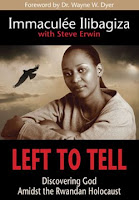
Left to Tell

by Imaculee Ilibagiza
Finished April 2011

I've been hearing about this book for a long time. Immculee Ilibagiza is Catholic, so I hear about her on the Catholic radio station and on the blogs I read. This is a true story of her life in Rwanda and her escape from the genocide there.

Ilibagiza is a Tutsi and, at this time in the history of Rwanda, Tutsis were considered second class citizens. Of course, for the most part, no one can tell a Hutu from a Tutsi from anyone else. There are physical characteristics that tend to run through the two tribes, but they are unreliable indicators. The people of Rwanda must carry identification cards to prove whether they are Hutu or Tutsi.

How in the world can a community of friends and neighbors turn into mindless monsters, hunting each other down and killing each other in the most terrible ways? The government of the dominant Hutus spread propaganda to their tribe members, convincing them that the Tutsis were evil and should be eliminated.

Immaculee had great faith in God to begin with, but her faith was tested time and time again through her ordeal. She got separated from her family, not knowing whether they survived the Hutu killers. She ended up hiding with at least seven other women in a small bathroom in the house of a village pastor. They hid for months because revealing themselves would be sure death.

Time and again God saved Immaculaee through miraculous, or at least providential, events. She could have been killed a number of times, but always escaped.

So now Immaculee is spreading the good news of Jesus Christ by telling her story. She hopes to bring people to Christ and to end violence through her message.

This is an amazing story. I am so glad I read it. I was worried that I wouldn't be able to get through it (after having read of the Rwandan genocide in the book Bonobo Handshake), but it wasn't so bad. Immaculee doesn't shield her readers from anything, but the hope and faith that she expresses in this book is the thing that will get you through the book.
I loved Immaculee's story of her early life and of her strong Catholic family.

I recommend that everyone read Immaculee's story.

Tuesday, October 26, 2010

Bonobo Handshake

A memoir of love and adventure in the Congo
by Vanessa Woods
Finished September 2010

I was without the internet at home for a while, so I'm just getting around to writing about this book. It's too bad, because I had a lot to say about it when I just finished reading it. Now I've kind of forgotten all of the details of what I wanted to say.

I picked this book up after browsing the new book shelf at the library. I wanted to read about bonobos. That's what the book is about, but I learned so much more.

Vanessa Woods is a research scientist and journalist. After graduating from college she began volunteering for the Taronga Zoo in Sydney. While there she heard about a "chimp island" for orphan chimpanzees.

"My job was to lead a team of Ugandans on a census, for which I had zero qualifications. Debby hired me only because the real primatologist got malaria and pulled out at the last minute."

She became enamored of a chimp named Baluku. She also fell in love with a real primatologist named Brian Hare. They married and she became more involved in primate research through her husband's activities.

Then they went to the Democratic Republic of the Congo to study Bonobos and to work on answering the question, "What makes us human?" Vanessa wasn't thrilled. She was more interested in going back to Uganda to study chimpanzees. What she learned while in the DRC about humans, bonobos and chimpanzees would change her life.

This book made a big impact on me. When the author arrived in the DRC she wasn't very aware of the political history nor of the current events of the Congo. She arrived during a very violent and politically unstable time. The stories she heard about the violence inflicted upon people are horrible. To think that people can be capable of doing such terrible things to other people is inconceivable. What makes this interesting and worth enduring the stories of war is the contrast between people and the chimps and bonobos. The chimps are also capable of inflicting violence on their own kind. Bonobos, however, are peace-loving. This isn't to say that they don't have squabbles with each other or that they don't treat each other badly. But squabbles and bad behavior are much different from true violence and cruelty.

We share 98.7% of our DNA with bonobos. We share 98% of our DNA with chimpanzees (a recent National Geographic article says 96%). We can see so much of ourselves in both. Woods' book is as much about humans as it is about the apes she studied.

This is such a fascinating book. It certainly gave me so much more than I expected. It made me sad, happy, horrified, amused and enlightened.
Bonobo Handshake official site
Your Inner Bonobo - Vanessa Woods Psychology Today blog
Friends of Bonobos - the support site for Lola Ya Bonobo, the world's only bonobo sanctuary.

Tuesday, September 7, 2010

I Have Heard You Calling in the Night

by Thomas Healy
Finished August 2010

This book was a pre-publication paperback that I found in the breakroom at work. The title caught my eye as well as the drawing of a dog on the cover. The description helped sell me:


Thomas Healy was a drunk, a fighter, sometimes a writer, often unemployed, no stranger to the police. His life was going nowhere but downhill. Then one day he bought a pup - a Doberman. He called him Martin. Gradually man and dog became unshakable allies, the closest of comrades, the best of friends. Martin, in more ways than one, saved Thomas Healy's life.

I love stories about dogs anyway, especially stories about the bond betweeen dog and human. But I held onto this book for a while before I finally read it.

It's an unusual book. The author's writing style is very colloquial and not very polished. Healy has written a book called The Hurting Business (about boxing) and two novels - Rolling and It Might Have Been Jerusalem. I haven't seen these other books, don't really know who published them, and don't know if they were ever widely read. If I didn't see the publisher name Harcourt on the back of the book, I'd have thought it was a self-published memoir.

This isn't to say that I didn't enjoy the book. It was interesting and touching. Thomas Healy, as the back cover blurb says, was a drunk and a trouble maker. On a pure drunken whim he bought a Doberman pup from an unscrupulous man and named him Martin. Healy saved Martin's life and Martin returned the favor. For some reason, having this dog was just the impetus he needed to stop his drinking. He would drink again, on occasion, and realistically remained an alcoholic. But, he wasn't an active drunk.

This isn't really a dog book. Martin is the miracle that changed the diretion of Healy's life, but the
one who was "calling in the night" is God. This is more the spiritual memoir of someone searching for something deep and lasting. Healy may not be a deeply religious person, even now. But the reader can see God working throughout his life in so many ways, calling him patiently.

I'm glad I finally picked the book up after having it on my shelf for at least two years.

Sunday, January 31, 2010

My Japan 1930-1951

by Hiroko Nakamoto as told to Mildred Mastin Pace
Finished January 31, 2010

The only problem with this book is that it left me wanting more. As the book ended, I wanted to know what happened to Hiroko Nakamoto. Of course, the book is called "My Japan 1930-1951." By design, it doesn't tell what happened to Ms. Nakamoto in her adult life.

This memoir tells the story of a little girl growing up in pre-war Japan. Strong traditions dictate how a girl may act and what type of future she'll have. Hikoro's plans for the future begin to change when Japan attacks the United States at Pearl Harbor and World War II begins. Women - even as young as 12 or 13 - begin to work in factories to support the war effort. It's a difficult transition for all, but especially for the young women who, up until then, had been learning how to be good wives, mothers, and homemakers. But even then, the plan was to return to the traditional ways after the gods granted victory to Japan.
Their plans would change forever on August 6, 1945.


It was 8:15 in the morning, and I was on my way to work. I was walking. The night before, as usual, there had been alerts all night. I was groggy from lack of sleep. The all clear had sounded just as I left home. Now all seemed calm and quiet. I did not hear any sounds of airplanes overhead. Suddenly, from nowhere, came a blinding flash. It was as if someone had taken a flashbulb picture a few inches from my eyes. There was no pain then. Only a stinging sensation, as if I had been slapped hard in the face. I tried to open my eyes. But I could not. Then I lost consciousness.


Of course, this was the day the atomic bomb was dropped on Hiroshima. A few days later, another was dropped on Nagasaki.
Witnessing the devastation of the recent natural disasters in New Orleans (hurricane) and Haiti (earthquake) we have some idea of the hopelessness that the destruction of a city can bring. It's a long difficult process to rebuild buildings and lives. How much worse it is to rebuild after the total destruction of an atomic bomb.

In addition to the physical devastation, the Japanese people had to face defeat. It turns out that their emperor was not guaranteed by the gods to be victorious. The American occupational forces arrived and long held, old fashioned traditions began to change. Life for the Japanese was never the same.

Life for Japanese women was certainly very different. The young women that had gone to work during the war realized that there was more for them than being a slave to house and home.
Even for those who would stay home, the primitive ways were not acceptable once they saw such modern conveniences as an American kitchen.
Families were torn apart, houses were destroyed and many people had to live in barracks and dormitories. The traditions of the strong Japanese family began to change as well.

This is Hiroko Nakamoto's story. As such, we don't get a complete picture of the war, the atomic bomb and it's aftermath. But, through Nakamoto's experiences we see what life was like for a young girl.

Any story of Hiroshima would be depressing, but Hiroko Nakamoto was such an inspiring, hopeful person that this book was a pleasure to read.

Friday, October 9, 2009

Flyaway

Flyaway: How a Wild Bird Rehabber Sought Adventure and Found Her Wings
by Suzie Gilbert
Finished October 6, 2009

I found this book when looking for new books about pets for a library bibliography. No, it isn't about pets, but I ran across it when looking for the subject "birds." I think I was attracted to the book because my family has been talking about birds and birdfeeders lately.


Suzie Gilbert worked as a volunteer at a raptor rehabilitation facility in New England. For reasons having something to do with internal politics, she quit that position and decided to strike out on her own. It became an idea that grew almost beyond Gilbert's capabilities. As she learned more and more about caring for wild birds, she learned more about herself and her family and their ability to cope during difficult times.

The stories of these birds Gilbert cared for were fascinating. They came to her for many reasons from simple wounds to injuries inflicted on purpose by cruel hearted people. Sparrows, wrens, finches, grackles, hawks, crows - Gilbert cared for a huge variety of birds. My favorite to read about were the crows. I have a new found respect for these intelligent and funny birds.

Suzie Gilbert's family was (is) charming and I enjoyed reading about them as much as I enjoyed the birds.

This book was a winner!


Thursday, July 30, 2009

Kitchen Privileges

a memoir by Mary Higgins Clark
Finished July 29, 2009
.
I'd never read anything by Mary Higgins Clark, who is famous for suspense novels. I've always considered her books to be cheap horror mysteries. But I've also always confused her books with V.C. Andrews' books. Poor Mary Higgins Clark. I'm sorry for the comparison! In any case, I should read one for myself and then make a judgement. The Mary Higgins Clark I met in this memoir doesn't write trashy horror.
I needed to read a biography for the last spot on my Summer Reading card. I don't like full biographies. So I searched for the keyword "memoir" in the library catalog and came up with this. What's not to love about the cover and title of this book? And the jacket flap told about Clark's childhood as a little Irish Catholic girl growing up in the Bronx. The title comes from the sign that mother Higgins put up to advertise her boarding house "Rooms to Rent with Kitchen Privileges."
Unfortunately, not enough of the book was about that childhood and the people that lived in the Higgins' boarding house. No matter, though. It was still a very enjoyable memoir. I learned the highlights and lowlights of the author's life. I found out how she became a bestselling writer. She was a very ordinary mother and wife who had a lot of heartache throughout her life. She remained optimistic and worked her way into being a real, published author. It wasn't easy as a woman and single mother to find a place in the working world at that time.
Obviously, she did become a success. Where Are The Children was her first suspense novel. I will read it now. I feel, after getting to know her through this memoir, that I owe her that much.

Thursday, May 14, 2009

The Glass Castle

by Jeannette Walls
Read May 2009 finished May 14

I read this because it's one of the choices for Tates Creek High School's summer reading list. I'm going to lead a discussion of this once school begins in August.
I only chose it because it looked the most interesting of the group. I wasn't thrilled about it.

I think the opening paragraph caught my attention. Jeannette is riding in a taxi through the streets of Manhattan. She lives in a Park Avenue Apartment and is on her way to a fancy party. While stopped at a stop light, she looks over to see a woman rooting through a trash can. It's her mother.

That caught my attention. What happens after that chapter sucked me in and kept me going. This is a memoir. A true story, although many people in Amazon's comments don't believe her story. But it's about her family's nomadic, countercultural lifestyle. Her dad, Rex Walls, is a thinker, a philospher, an inventor, a fun dad and a drunken no goodnik. The lifestyle he forces on his family is both a gift and a curse to them. The children, for the most part, grow up to be creative, intelligent adults.

It was difficult to decide whether I liked Rex for his romantic notions and amusing ideas or despised him for the neglect and subtle abuse of his children.

Rose Mary Walls, the mother, is not much better. But she is a ditzy artist who follows whatever her husband says and does and doesn't have the strength to give her children a better life, even when her kids are living in the worst poverty imaginable in West Virginia.

This was a very good, thought provoking read. Was it all true? I have no idea. Ireally don't care. It read like a novel and it was fascinating, funny and sad all at the same time.

Tuesday, November 18, 2008

Called Out of Darkness

Called Out of Darkness: A Spiritual Confession
by Anne Rice
Read November 2008

This is a spiritual memoir. Not very much like the "girl meets God" stories that I like so well. But it really is a "girl meets God" story.

Ann Rice was raised in a Catholic family and went to church. She was raised with religion. But she drifted away and almost pushed it away. She became an atheist.
She famously wrote a lot of vampire novels and, not so famously, wrote erotic stories.

But she began to have a conversion. I read this several months ago, so I can't remember what precipitated the conversion. She returned to New Orleans and later returned to her Catholic fatih.

Stories of conversion really fascinate me. I wonder what can turn someone around so completely?

Thursday, July 10, 2008

Trespassers Will Be Baptized

by Elizabeth Emerson Hancock

This is another religous memoir that was suggested by Amazon in relation to Take This Bread. It's quite different from that book, however. It's written by a young girl who grew up as the daughter of a Baptist minister. She was imbued with religion all her life. Still, there are revelations in her life and moments of conversion.

This book is really funny. Hancock has a great sense of humor. Her father is no longer a minster. He now, I think, works at the Baptist seminary in Lexington (or Woodford Co, maybe). Elizabeth herself was a member of Central Baptist Church in Lexington.

Wednesday, June 4, 2008

What Would Barbra Do?

What Would Barbra Do? How Musicals Changed My Life
by Emma Brokes
Read June 2008


When I looked back at my calendar and saw that the week of June 2 I finished reading the book What Would Barbra Do?, I could not even guess what the book was about.

Quick check of Amazon... Oh yeah! I liked this one. It's another girl memoir, but not "girl meets god", but snarky girl shares her memories of childhood and her love of Broadway musicals. This was a fun book. The memoir is a genre I, obviously, like. The subject matter had me wanting to rent a bunch of these musicals.

Can't really say much else about it. It's been a year since I read it and, while it was enjoyable, it was fluffy.